
Luxembourg taxation: tips and practical examples
Passionate about Luxembourg taxation, I would like to share this passion with you and help you understand its various aspects.
This page is dedicated to English-speaking individuals and provides explanations of the different tax return forms, the specific tax rules for residents and cross-border workers, and the possible tax deductions applicable to your personal situation.
Drawing on my certifications and experience in Luxembourg accounting, insurance and real estate, I aim to make taxation more accessible through educational articles, practical advice and real-life examples.
My goal is to share my knowledge, provide genuine added value and help you better understand your tax affairs independently.
Because knowledge deserves to be shared, all these resources are available free of charge.
Luxembourg tax reform 2028: What will change?
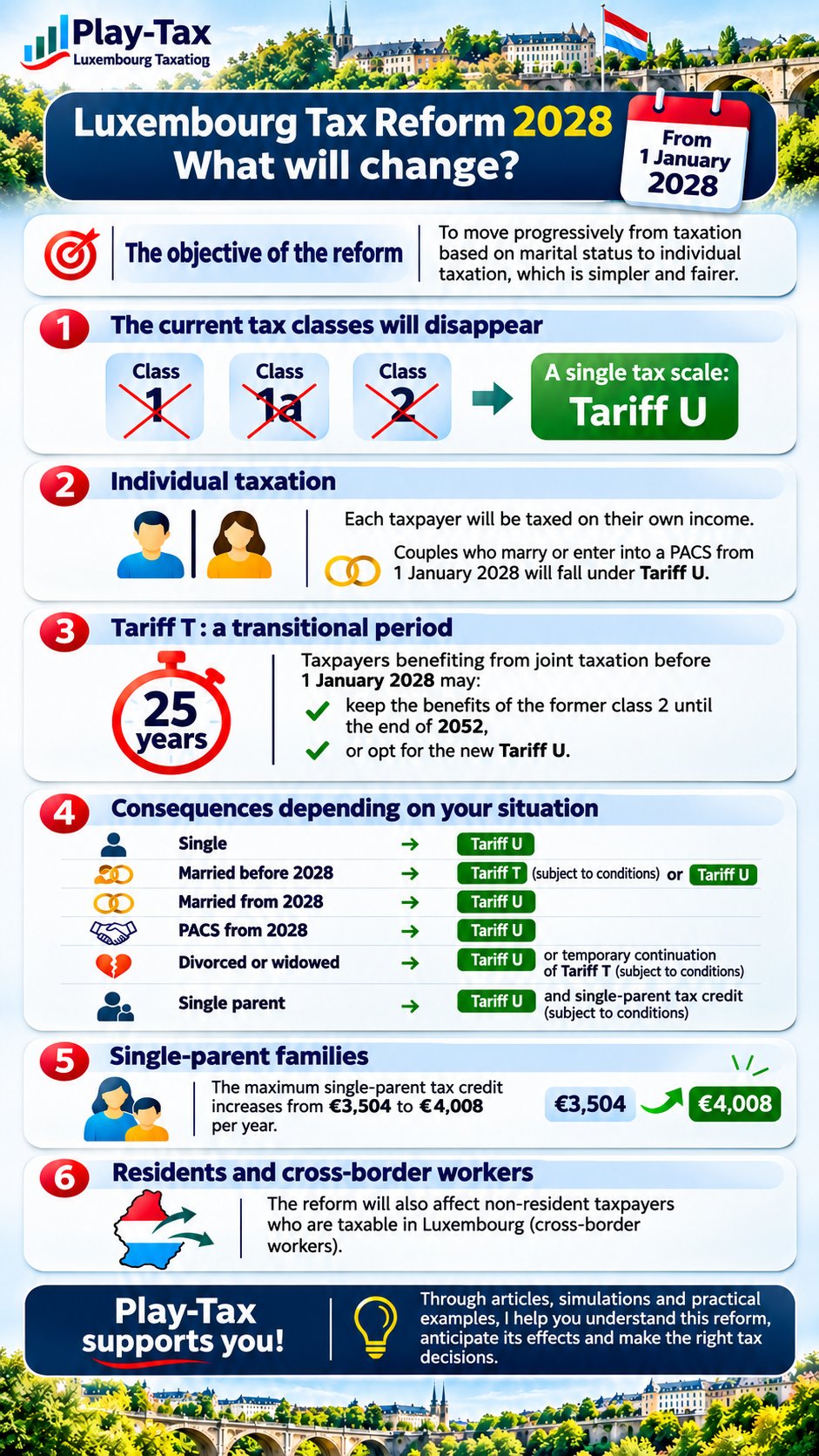
On 28 October 2026, the Chamber of Deputies adopted Bill No. 8676 on the reform of personal income taxation, which is scheduled to enter into force on 1 January 2028.
This reform represents a major change in Luxembourg taxation, with a gradual transition from taxation based on marital status to individual taxation.
1. The gradual abolition of tax classes
The three existing tax classes (1, 1a and 2) will gradually be replaced by a single tax scale known as Tariff U.
2. Individual taxation
Each taxpayer will be taxed on their own income. Couples who marry or enter into a registered partnership (PACS) from 1 January 2028 will also be subject to individual taxation.
3. Tariff T: a 25-year transitional period
Taxpayers benefiting from joint taxation before 1 January 2028 may, subject to certain conditions, retain the benefits of the former tax class 2 until the end of 2052.
They may also opt for the new Tariff U.
4. The consequences according to your family situation
Family situation |
From 2028 |
|---|---|
Single |
Tariff U |
Married before 2028 |
Tariff T subject to conditions or Tariff U |
Married from 2028 |
Tariff U |
Registered partnership from 2028 |
Tariff U |
Divorced or widowed |
Tariff U or temporary Tariff T subject to conditions |
Single parent |
Tariff U and single-parent tax credit subject to conditions |
5. Single-parent families
The maximum single-parent tax credit will increase from €3,504 to €4,008 per year.
6. Residents and cross-border workers
The reform will also affect non-resident taxpayers who are taxable in Luxembourg. It is therefore important to understand the consequences of the new system for your personal tax situation.
The objective of Play-Tax
Through articles, simulations and practical examples, I will help you understand this reform, anticipate the changes and make the right tax decisions.
Official source: Ministry of Finance – Tax reform 2028.
Information updated on 25 November 2026. Implementation rules should continue to be monitored until the reform enters into force.
The Luxembourg tax card: Why is it important?
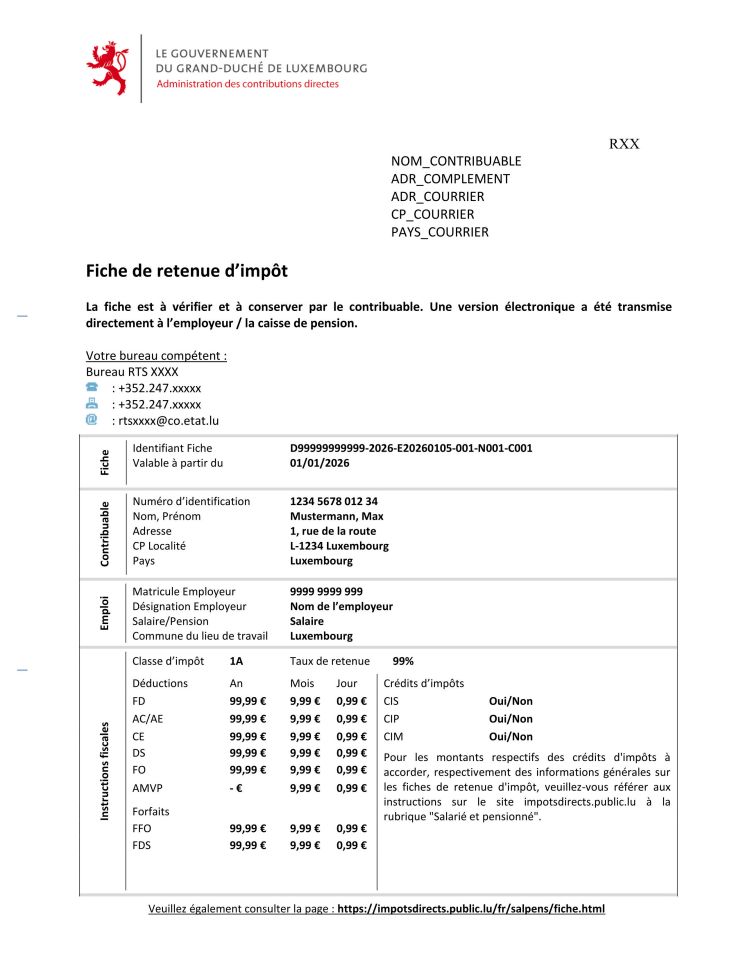
The tax withholding card, commonly known as the “tax card”, is an essential tax document for employees and civil servants subject to taxation in Luxembourg, whether they are residents or cross-border workers.
It enables your employer to correctly calculate the tax withheld from your salary each month.
1. Avoiding excessive tax withholding
In the absence of a valid tax card, the employer applies the provisions of tax class 1, with a tax withholding rate of at least 33%.
Since 1 January 2022, the Luxembourg Direct Tax Administration (Administration des contributions directes – ACD) has made the tax card available electronically to your employer. However, it remains your responsibility to check that it has been correctly issued.
2. Checking your tax information
The main information to check includes:
-
Your personal details.
-
Your tax class.
-
Your withholding tax rate, where applicable.
-
Your travel expenses (FD).
-
Your special expenses (DS).
-
Your extraordinary expenses (CE).
-
Any tax allowances recorded on the card.